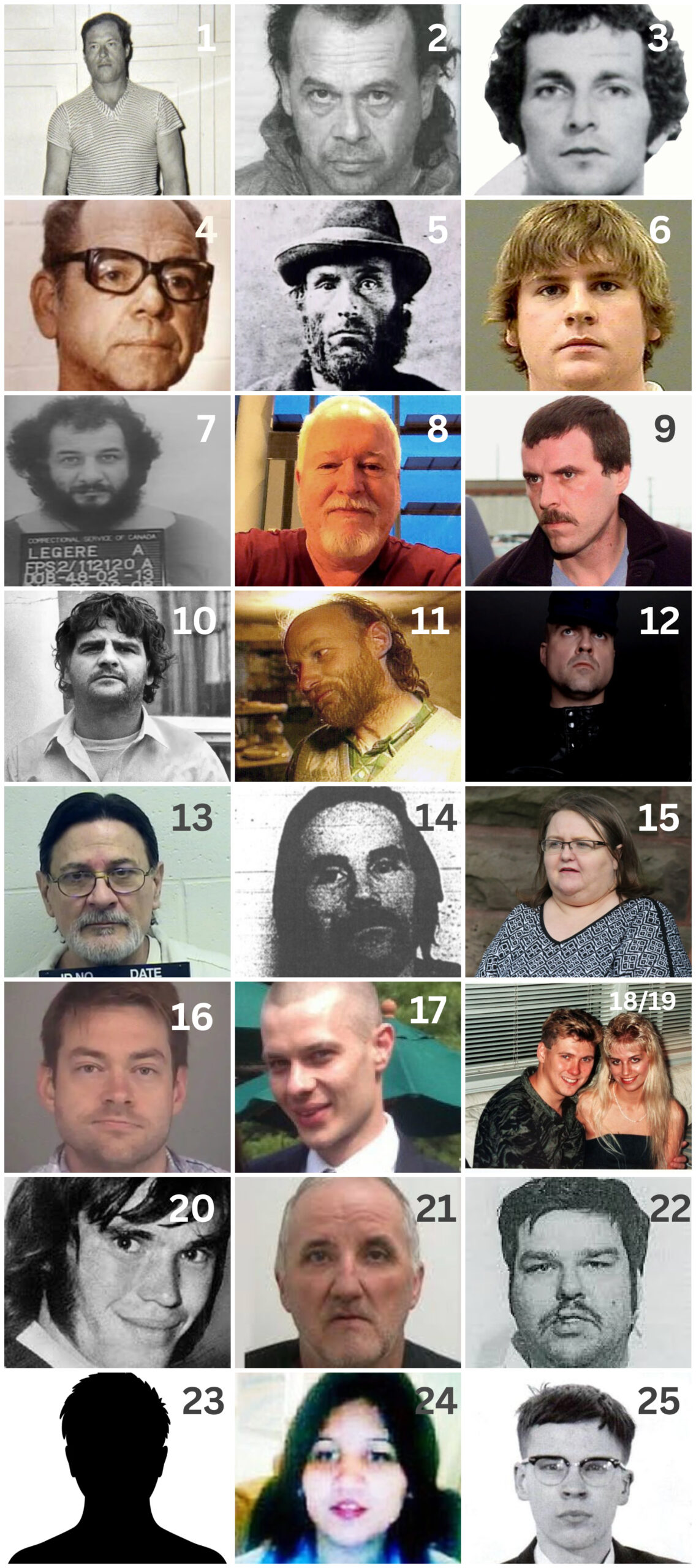
1 – Léopold Dion: “The Monster of Pont-Rouge”
Born 1920
Léopold Dion, known as the “Monster of Pont-Rouge,” was a Canadian sex offender and serial killer active in Quebec in the early 1960s. His criminal history began in his teenage years and included multiple convictions and prison sentences before he was eventually released on parole in the early 1960s. After his release, he committed a series of serious crimes involving young boys over a short but devastating period.
Dion targeted boys by posing as a photographer, using the promise of taking pictures to gain their trust. He would then lure them away from populated areas and carry out violent assaults. He was responsible for the deaths of four boys between May and June 1963, and also assaulted many others. His crimes caused widespread fear in Quebec due to the vulnerability of his victims and the deceptive method he used.
He was arrested in 1963 after one of his intended victims escaped and provided a description that helped police identify him. Dion later confessed and led investigators to the locations where the victims were buried. Although he was initially sentenced to death, the punishment was later reduced to life imprisonment on appeal.
Dion remained in prison until his death in 1972, when he was killed by another inmate. His case remains one of the most infamous in Canadian criminal history due to the scale of his crimes and the way he repeatedly reoffended after being released on parole.
Known victims of Léopold Dion:
Guy Luckenuck 12: Lured from a Quebec City train station on April 20, 1963, under the ruse of being a photographer.
Alain Carrier 8: Killed on May 5, 1963, in Saint-Raymond-de-Portneuf after Dion used the same photography ruse to lure him and Michel Morel.
Michel Morel 10: Murdered alongside Alain Carrier on May 5, 1963.
Pierre Marquis 13: Killed on May 26, 1963, near the location where Guy Luckenuck was buried. Dion was ultimately only convicted of this specific murder.
2 – William Patrick Fyfe
Born 1955
William Patrick Fyfe was a Canadian serial offender convicted of killing five women in the Montreal area of Quebec, with suspicions linking him to several additional cases. Born in Toronto and raised in Montreal, he later worked as a handyman, a job that may have given him access to victims’ homes. Investigators believe his crimes began in the late 1970s and continued intermittently into the 1990s.
Fyfe’s crimes were not connected for many years until advances in forensic science helped link him to a series of cases. In particular, DNA evidence found at one crime scene became a key breakthrough that eventually led to his arrest in 1999 in Ontario. He was convicted after a lengthy investigation and trial and was sentenced to life in prison, where he remains.
Authorities confirmed five victims, all women living in Quebec, with incidents spanning from the late 1970s to 1999. Beyond the confirmed cases, Fyfe is also suspected in several earlier and similar deaths across Quebec dating back to 1979. Some investigators have also suggested he may be connected to other unsolved violent attacks in Montreal during the 1980s, though these remain unproven. His case is often cited as an example of how DNA technology helped solve long-standing cold cases and link crimes across decades.
Confirmed victims:
Hazel Scattolon 52 – killed in 1981 in Town of Mount Royal, Quebec
Anna Yarnold 59 – killed October 15, 1999 in Senneville, Quebec
Monique Gaudreau 46 – killed October 29, 1999 in Sainte-Agathe-des-Monts, Quebec
Teresa Shanahan 55 – killed in November 1999 in Laval, Quebec
Mary Glen 50 – killed December 15, 1999 in Baie-D’Urfé, Quebec
Suspected victims:
Suzanne Bernier – killed October 17, 1979 in Montreal, Quebec
Nicole Raymond – killed November 11, 1979 in Pointe-Claire, Quebec
Louise Blanc Poupart – killed in 1987 in Sainte-Adèle, Quebec
Pauline Laplante – killed in 1989 in Piedmont, Quebec
3 – Russell Maurice Johnson: “The Bedroom Strangler”
Born 1947
Russell Maurice Johnson, known as “The Bedroom Strangler,” was a Canadian offender active in the 1970s in Ontario. Johnson was an automotive store clerk and weightlifter, and was later linked to a series of serious crimes involving women in the London and Guelph areas. Authorities ultimately connected him to multiple deaths and additional violent attacks over several years.
His pattern involved targeting women living in apartment buildings. He would often observe their routines and then gain entry by climbing balconies or exterior walls, typically at night. Once inside, he would carry out violent attacks while the victims were asleep. In several cases, the deaths were initially believed to be from natural or medical causes because there were few obvious signs of struggle, which delayed the discovery of what had actually happened.
Over time, investigators identified multiple victims, including students and working women. Johnson was arrested in 1977 after being charged in connection with several of these deaths. During legal proceedings, he admitted responsibility for additional cases beyond those originally investigated.
Psychiatric evaluations found that he was suffering from severe mental illness, and the court ultimately determined he was not criminally responsible for his actions. Instead of prison, he was placed under indefinite care in a secure mental health facility, where he has remained under supervision.
Known Victims of Russell Maurice Johnson
Mary-Catherine Hicks, 20 – University student in London, Ontario. Found dead in her bed in late 1973. No signs of struggle. Death was first thought to be due to a medical or drug-related cause, later linked to a confession in 1977.
Alice Ralston, 42 – Guelph, Ontario resident. Died in her sleep in late 1973. Originally recorded as a natural death before being connected to later confessions.
Eleanor Hartwick, 27 – Found in summer 1974. Appeared to have died peacefully in bed at her home.
Doris Brown, 49 – Guelph, Ontario. Died between August 8 and 9, 1974. Found by her daughter in bed. Death was initially considered natural or unexplained and later admitted in a confession.
Diane Beitz, 23 – Found on New Year’s Eve 1974 by her fiancé. Died following a violent attack in her apartment. The case was heavily investigated at the time and later linked through confession.
Louella Jeanne George, 23 – Died April 14 to 15, 1977. Attacked in her fourth-floor apartment after someone entered via a balcony. Personal belongings were later found near the scene.
Donna Veldboom, 22 – Died July 16, 1977 in her apartment. Lived above the offender. The case involved a violent attack, and the scene was altered before discovery.
4 – Gilbert Paul Jordan: “The Boozing Barber”
Born 1931
Gilbert Paul Jordan, often referred to as “The Boozing Barber,” was a Canadian serial killer linked to a series of deaths in Vancouver between the 1960s and late 1980s. A former barber with a long criminal history, Jordan became known for a disturbing pattern: he would target vulnerable women—many from marginalized communities—by meeting them in bars and encouraging extreme alcohol consumption. Authorities believe he was connected to between eight and ten deaths, though he was only ever convicted in one case.
His method was unusual and insidious. Jordan would supply large amounts of alcohol to his victims, often continuing even after they lost consciousness. Many of these deaths were initially ruled as alcohol poisoning, which delayed suspicion and allowed his pattern to go unnoticed for years. Investigators later uncovered evidence that he had repeated this behavior with numerous women, highlighting both the scale of his actions and the systemic failures that contributed to the lack of early intervention.
In 1987, the death of a woman named Vanessa Buckner became a turning point. Evidence, including fingerprints and witness accounts, tied Jordan directly to the killing, leading to increased police surveillance. During this time, officers intervened in several situations where other women were at risk. In 1988, Jordan was convicted of manslaughter in Buckner’s death and sentenced to prison, though he served only part of his sentence.
Even after his release, Jordan continued to have run-ins with the law for violating probation conditions, particularly those involving alcohol and contact with women. His case later drew attention not only for the crimes themselves, but also for how they exposed gaps in the justice system and the way vulnerable victims were often overlooked. Jordan died in 2006, but his story remains a troubling example of how predatory behavior can persist when warning signs are missed.
Known Victims of Gilbert Paul Jordan:
Vanessa Buckner – Died in 1988 in Vancouver; case that led to Jordan’s manslaughter conviction.
Rosemary Wilson – Nov 20, 1987, Balmoral Hotel (blood alcohol level: 0.52).
Verna Chartrand – Nov 21, 1987, Pacific Hotel (blood alcohol level: 0.43).
Sheila Joe – Nov 25, 1987, Rainbow Hotel.
Mabel Olson – Nov 26, 1987, Pacific Hotel.
Ivy Rose – 1965, found dead in a Vancouver hotel (blood alcohol level: 0.51).
Mary Johnson – Nov 30, 1980, Aylmer Hotel (blood alcohol level: 0.34).
Barbara Paul – Sept 11, 1981, Glenaird Hotel (blood alcohol level: 0.41).
Mary Johns – July 30, 1982, found in Jordan’s barber shop (blood alcohol level: 0.76).
Patricia Thomas – Dec 15, 1984, found in Jordan’s barber shop (blood alcohol level: 0.51).
Patricia Andrew – June 28, 1985, found in Jordan’s barber shop (blood alcohol level: 0.79).
Vera Harry – Nov 19, 1986, Clifton Hotel (blood alcohol level: 0.04).
Edna Shade – Died in a hotel room while with Jordan (date not specified).
5 – Joseph LaPage: “The French Monster”
Born 1838
Joseph LaPage, also known as “The French Monster,” was a 19th-century criminal who committed a series of violent crimes in both Canada and the United States. Born in Quebec in 1838, he initially lived a seemingly ordinary life as a husband and father, but developed a reputation for abusive and aggressive behavior. Over time, his actions escalated, including assaults on family members and other women, eventually forcing him to flee to the United States to avoid arrest.
In the 1870s, LaPage carried out several murders, including the killing of a schoolteacher in Vermont and a teenage girl in New Hampshire. These crimes were particularly shocking for their brutality and helped spark widespread fear in the communities where they occurred. After the second killing, authorities were able to track him down and arrest him, thanks in part to witness accounts and earlier suspicions.
LaPage was convicted and sentenced to death, ultimately being executed by hanging in 1878. Before his execution, he confessed to multiple killings, and he was later suspected in additional earlier murders in Quebec. His case remains one of the more disturbing examples of violent crime from that era, highlighting both the limits of early policing and the lasting impact such crimes had on small communities.
Confirmed Victims
LaPage confessed to these murders shortly before his execution:
Josie Langmaid 17 – Killed on October 4, 1875, in Pembroke, New Hampshire. She was on her way to school when she was attacked and murdered.
Marietta Ball (approx. 20) – Killed on July 24, 1874, in St. Albans, Vermont. A schoolteacher who was followed and attacked by LaPage. He was suspected at the time but only admitted responsibility years later.
Victims Linked After His Death
Mrs. George Fountie – Believed to have been killed in 1867 in Saint-Alexandre, Quebec.
Minnie Fountie 16 – Her daughter, also believed to have been killed in the same incident.
Other Known Crimes
Julienne Rousse – LaPage’s sister-in-law, who survived a violent attack in 1871 and later testified against him.
Unidentified Woman – In 1872, LaPage was suspected of attacking a young woman with a weapon, leaving her seriously injured.
6 – Cody Legebokoff
Born 1990
Cody Legebokoff, born on 21 January 1990, is a Canadian serial killer who was convicted in 2014 of murdering four young women and a teenage girl in northern British Columbia between 2009 and 2010. His crimes, which took place around Prince George, drew national attention, in part because of his young age he was just in his late teens and early twenties at the time making him one of the youngest serial killers in Canada. One of his victims has also been connected to the broader “Highway of Tears” cases involving missing and murdered women.
Before his arrest, Legebokoff appeared to live a relatively ordinary life. Raised in Fort St. James, he was known as a social and active young man with no obvious history of serious violence. He later moved to Prince George, where he worked and lived with friends, staying largely off police radar.
His crimes came to light in November 2010 during a routine traffic stop by an RCMP officer who noticed suspicious behavior on a remote road at night. A search of Legebokoff’s vehicle uncovered evidence that led officers to a nearby crime scene. Following his arrest, further investigation and DNA evidence connected him to three additional killings, ultimately leading to his conviction.
Known Victims of Cody Legebokoff:
Jill Stacey Stuchenko 35 – A mother of six who was last seen on October 9, 2009. Her body was discovered four days later in a gravel pit on the outskirts of Prince George.
Natasha Lynn Montgomery 23 – A mother of two who was last seen around August 31 or early September 1, 2010. Her body has never been found, but DNA evidence later linked her to Legebokoff’s apartment.
Cynthia Frances Maas 35 – Last seen on September 10, 2010. Her body was found the following month in a park in Prince George. She died from severe injuries, including blunt-force trauma and multiple fractures. Authorities stated that Stuchenko, Montgomery, and Maas were involved in the sex trade. Legebokoff reportedly struggled with drug use and had connections to sex workers.
Loren Dawn Leslie 15 – Killed on November 27, 2010. She was significantly younger than the other victims and is believed to have met Legebokoff online. Leslie had limited vision and is also counted among victims associated with the “Highway of Tears” cases in northern British Columbia.
7 – Allan Legere: “The Monster of the Miramichi”
Born 1948
Allan Legere, often referred to as the “Monster of the Miramichi,” was a Canadian criminal responsible for a series of violent crimes in New Brunswick. In 1986, he took part in a brutal home invasion targeting an elderly couple, which resulted in the death of the husband and serious harm to the wife. He was arrested, convicted, and sent to prison for his role in the attack.
In 1989, while being treated at a hospital, Legere managed to escape custody. Over the next several months, he carried out a string of attacks across the Miramichi region, killing four people and evading police in one of the largest manhunts in the province’s history. His actions created widespread fear in local communities before he was eventually captured in November 1989.
Legere was later convicted of the additional murders, in a trial that notably involved one of the first uses of DNA evidence in Canada to secure a conviction. He remained behind bars for the rest of his life, with multiple parole requests denied over the years. Legere died in custody in 2026 at the age of 78.
Known Victims of Allan Legere:
John Glendenning (1986) – A 66-year-old convenience store owner beaten to death during a home invasion.
Annie Flam (May 1989) – A 75-year-old shopkeeper beaten to death; her home was set on fire.
Donna Daughney (October 1989) – A 45-year-old woman, murdered along with her sister.
Linda Daughney (October 1989) – A 40-year-old woman, sister to Donna.
Father James Smith (November 1989) – A 69-year-old Catholic priest beaten to death in his rectory
Assaults and Other Victims
Mary Glendenning (1986) – Survived a brutal beating and sexual assault during the same incident that killed her husband, John.
Nina Flam (May 1989) – Sister-in-law to Annie Flam, she was raped, beaten, and left in the burning home, but survived.
Unnamed Victim (May 1989) – A woman taken hostage in a carjacking during the escape, left unharmed.
Max Ramsay (May 1989) – Beaten, tied up, and robbed.
9 – Michael Wayne McGray
Born 1965
Michael Wayne McGray is a Canadian serial killer convicted of multiple murders committed between the mid-1980s and late 1990s. Born in Ontario and raised in Nova Scotia, his crimes spanned several provinces and involved both strangers and people he encountered casually. He was officially convicted in connection with several killings, though he later claimed responsibility for additional victims across Canada.
McGray’s violent history began in 1985 with the killing of a teenage hitchhiker in Nova Scotia. Over the years, he continued committing serious crimes, including multiple murders in Montreal while on a temporary release from prison in 1991. In 1998, he carried out one of his most widely known attacks in New Brunswick, where a mother and her young daughter were found dead in their home. He was arrested shortly afterward and later admitted to some of his earlier crimes.
While in custody, McGray continued to draw attention for his behavior, including the killing of another inmate in 2010. Investigators have also linked him to additional unsolved cases, and some wrongful conviction concerns have surfaced in cases where he was later identified as a possible suspect. His case remains one of the more disturbing examples of repeat violent offending in Canada, with a pattern of crimes stretching over decades.
Known Victims of Michael Wayne McGray:
Elizabeth Gail Tucker (1985): A 17-year-old hitchhiker found near Weymouth, Nova Scotia. McGray was convicted of her murder in 2001 after providing details that corroborated the cold case
Mark Daniel Gibbons (1987): An accomplice in a taxi robbery who was stabbed to death by McGray in Saint John, New Brunswick.
Robert Assaly (1991): A 59-year-old retired teacher murdered in Montreal while McGray was on a three-day weekend pass from prison.
Gaetan Ethier (1991): A 45-year-old man also killed in Montreal during the same weekend pass as Robert Assaly.
Joan Hicks (1998): A 48-year-old woman stabbed in her Moncton, New Brunswick, apartment. McGray pleaded guilty to her murder in 2000.
Nina Hicks (1998): Joan’s 11-year-old daughter, who was strangled during the same attack. McGray eventually pleaded guilty to her murder in 2001
Jeremy Phillips (2010): McGray’s 33-year-old cellmate at the Mountain Institution in British Columbia. McGray strangled him shortly after being moved into a shared cell.
10 – Clifford Olson
Born 1940
Clifford Olson was a Canadian serial killer who confessed to murdering 11 children and teenagers in British Columbia in the early 1980s. His crimes, committed over a short period in 1980 and 1981, shocked the country due to both the number of victims and their young ages, ranging from 9 to 18. The killings ended with his arrest in August 1981 after he was identified as a suspect in an attempted abduction.
After his arrest, Olson struck a highly controversial deal with investigators. He agreed to confess and lead police to the victims’ remains in exchange for payments made to his family. In 1982, he pleaded guilty to 11 counts of murder and received multiple life sentences, ensuring he would spend the rest of his life in prison.
Olson remained incarcerated for decades and was repeatedly denied parole. His case continued to draw public attention over the years, including controversy when it was revealed he had been receiving government pension benefits while in prison, prompting changes to the law. He died in custody in 2011 after being diagnosed with cancer.
Known Victims of Clifford Olson:
Christine Weller 12
Colleen Marian Daignault 13
Daryn Todd Johnsrude 16
Sandra Wolfsteiner 16
Ada Anita Court 13
Simon Partington 9
Judy Kozma 14
Raymond King II 15
Sigrun Arnd 18
Terri Lyn Carson 15
Louise Chartrand 17
13 – Gary Allen Srery
Other names linked to Srery: Rex Long, David Blackwell, Rex Edward Long, Travis Blackwell and Gary Delorme
Born 1942
Gary Allen Srery was an American criminal responsible for the deaths of at least four young women in Calgary, Alberta between 1976 and 1977. The victims, aged 14 to 20, were found over the span of about a year, but the cases were not connected at the time. Decades later, DNA evidence linked the crimes, and in 2024, investigators used genetic genealogy to identify Srery as the suspect. Because he had already died in 2011, he was never formally charged.
Prior to coming to Canada, Srery had an extensive criminal history in the United States involving violent offences. In 1974, while facing charges, he fled the country and entered Canada illegally. He lived in Alberta and British Columbia under different identities, working various jobs and avoiding attention, which allowed him to remain undetected during the time of the killings.
In 1998, Srery was arrested in British Columbia for another serious offence and served time in Canada before being deported to the United States in 2003. He was later convicted in Idaho and sentenced to life in prison, where he remained until he died in 2011.
Known victims of Gary Allen Srery:
Eva Violet Dvorak 14 – Found dead on February 15, 1976, under the Happy Valley Overpass west of Calgary. She was found alongside her close friend Patricia McQueen.
Patricia “Patsy” Marie McQueen 14 – Found with Eva Dvorak on February 15, 1976. Both girls had been last seen walking in downtown Calgary the previous evening and were determined to have died of asphyxiation.
Melissa Ann Rehorek 20 – A hotel housekeeper originally from Windsor, Ontario. Her body was found in a ditch along Highway 1 west of Calgary on September 16, 1976, one day after she intended to hitchhike to the mountains. She died from manual strangulation.
Barbara Jean MacLean 19 – Originally from Nova Scotia and working at a local bank. She was found by a dog walker in Calgary on February 26, 1977, six hours after leaving a hotel bar alone.
14 – Yves Trudeau
Born 1946
Yves “Apache” Trudeau was a Canadian outlaw biker and contract killer who became one of the most notorious figures in the country’s organized crime history. Born in 1946, he rose through Quebec’s violent biker scene in the 1970s, ultimately becoming a key enforcer for the Hells Angels. Over the course of his criminal career, he admitted to involvement in the killings of dozens of people, many tied to biker wars over drug trafficking and territory.
Trudeau’s reputation grew during a period of intense gang conflict in Quebec, where rival motorcycle clubs fought brutal battles for control of the illegal drug trade. Known for his willingness to use extreme violence, including bombings and shootings, he became one of the Hells Angels’ most feared assassins. His actions played a significant role in several major biker wars that left many dead and reshaped organized crime in the region.
In 1985, following internal conflict within the Hells Angels and fearing for his life, Trudeau turned Crown witness and confessed to numerous killings in exchange for a reduced sentence. He was convicted of multiple counts of manslaughter and sentenced to life in prison, becoming eligible for parole after seven years.
He was released on parole in 1994 under a new identity, but later reoffended, including a sexual assault conviction that returned him to prison. After spending his final years in custody, he died in 2008 following a cancer diagnosis. Trudeau remains widely regarded as one of Canada’s most prolific and infamous contract killers.
Known Victims of Yves Trudeau:
1970 – Jean-Marie Viel
Trudeau’s first known victim. Viel was shot and killed in Trois-Rivières after stealing a motorcycle from the Popeyes.
February 17, 1978 – Robert Côté
Shot with a machine gun outside the Brasserie Joey in Montreal after he was heard shouting insults at Hells Angels members inside.
March 21, 1978 – Gilles Cadorette
President of the Montreal Outlaws chapter. Killed by a car bomb planted by Trudeau.
November 10, 1978 – Brian Powers
Outlaw leader shot multiple times in the head at his home in Sainte-Geneviève.
December 8, 1978 – William Weichold
Trudeau mistakenly killed Weichold, believing he was an Outlaw target. He later realized the victim was uninvolved in organized crime.
March 29, 1979 – Roland “Roxy” Dutemple
Killed by a car bomb after previously being mistaken for another target.
April 3, 1979 – Robert Labelle
Leader of the Huns gang in Laval. Shot after answering his front door.
May 9, 1979 – Donald McLean and Cameran Piche
Killed when a bomb attached to McLean’s motorcycle exploded.
February 1980 – Jeanne, André, and Berthe Desjardins
Three family members were killed in a series of attacks connected to biker conflicts; two bodies were later disposed of in the St. Lawrence River.
March 14, 1981 – Robert Morin
Killed by a car bomb placed under his vehicle.
May 9, 1981 – Donat Lemieux and Lucie Vallières
Shot and killed on their porch in Rosemont.
October 27, 1981 – Patrick “Hughie” McGurnaghan
West End Gang associate was killed when a bomb exploded in his Mercedes-Benz.
January 1982 – Charlie Hachez
Hells Angels North Chapter member was killed due to internal disputes involving drugs and financial conflicts.
January 1982 – Denis “Le Curé” Kennedy
Former Popeye and Hells Angel leader involved in a kidnapping plot; shot and killed after being lured to a meeting.
May 7, 1983 – André Forget
Shot at a gas station, one of Trudeau’s associates.
July 7, 1983 – Ronald Bernard
Another associate of Trudeau was killed in a shooting.
July 1983 – Michel Desormiers
Killed due to mafia-related conflict; the hit was coordinated with approval from organized crime figures.
October 10, 1983 – Raymond Filion
Shot outside his sister’s home in Laval.
1984 – Phillipe Galipeau and Rachelle Francoeur
Killed in their home after being targeted in a drug-related contract killing.
November 25, 1984 – Paul April, Robert Lelièvre, Louis-Charles Paquette, and Gilles Paquette
Killed in a major bombing carried out using an explosive device hidden in a television set. Several others were injured in the attack.
May 1, 1985 – Jean-Marc “La Grande Maw” Deniger
Strangled and his body was abandoned in a vehicle after being killed over drug-related disputes.
15 – Elizabeth Wettlaufer
Born 1967
Elizabeth Wettlaufer is a former Ontario nurse who was convicted of murdering eight elderly patients and attempting to murder several others between 2007 and 2016 while working in long-term care homes. She used insulin to carry out the attacks, which took place across multiple facilities in southwestern Ontario.
In 2016, while in a rehabilitation program, Wettlaufer confessed to her crimes, leading to her arrest and a full investigation. She later pleaded guilty to multiple charges, including first-degree murder, and was sentenced in 2017 to eight concurrent life sentences with no chance of parole for 25 years.
The case prompted major changes in Ontario’s long-term care system, including a public inquiry into patient safety and regulatory oversight. The College of Nurses of Ontario also permanently revoked her nursing license, calling her conduct among the most serious cases of professional misconduct it had ever seen.
Victims:
James Silcox 84: Died August 11, 2007.
Maurice Granat 84: Died December 23, 2007.
Gladys Millard 87: Died October 14, 2011.
Helen Matheson 95: Died October 27, 2011.
Mary Zurawinski 96: Died November 7, 2011.
Helen Young 90: Died July 14, 2013.
Maureen Pickering 79: Died March 28, 2014.
Arpad Horvath 75: Died August 31, 2014.
16 & 17 – Dellen Millard & Mark Smich
Born 1985 / 1987
Dellen Millard and Mark Smich are two Toronto men convicted of multiple high-profile murders that shocked communities across Ontario. Together, they were found guilty of killing Tim Bosma in 2013 and Laura Babcock in 2012, while Millard was also separately convicted of murdering his own father. Their crimes, marked by calculated planning and extreme violence, ultimately led to multiple life sentences.
Millard came from a wealthy aviation family and had a privileged upbringing, while Smich had a more troubled background that included minor criminal offences. The two became close friends over time, with Smich often seen as being heavily influenced by Millard. Their relationship evolved into one centered around reckless and sometimes criminal behaviour, including late-night thefts.
The murder of Tim Bosma began as what appeared to be a routine test drive after Bosma listed his truck for sale online. Millard and Smich arranged to meet him, but during the drive, Bosma was killed and his body was later burned. The case quickly drew widespread attention, and a detailed police investigation led to both men’s arrests and eventual convictions for first-degree murder, even though it was never proven who fired the fatal shot.
The pair were later convicted in the death of Laura Babcock, a young woman who disappeared the year before Bosma’s murder and whose body has never been found. Evidence showed she had been killed, leading to additional life sentences. Millard was also found guilty of killing his father, a case initially ruled a suicide before being reopened by investigators.
Both men received life sentences, originally with extended periods before parole eligibility due to the multiple murders. However, a later Supreme Court of Canada decision reduced those ineligibility periods, making them eligible to apply for parole after 25 years.
Known Victims are:
– Tim Bosma – murdered in May 2013 after meeting Millard and Smich for a truck test drive
– Laura Babcock – killed in July 2012; her body has never been recovered
– Wayne Millard – Dellen Millard’s father, murdered in November 2012 (initially ruled a suicide before being reinvestigated)
18 & 19 – Paul Bernardo & Karla Homolka “Ken and Barbie killers”
Born 1964 / 1970
Paul Bernardo is a Canadian criminal who became known for a series of serious violent offences in Ontario during the late 1980s and early 1990s. He was first identified by police in connection with multiple sexual assaults in the Scarborough area before the case escalated into several high-profile murders that drew national attention.
Bernardo later committed crimes alongside his partner, Karla Homolka, including the deaths of three young victims between 1990 and 1992. The cases involved the use of drugs and resulted in the deaths of teenagers Leslie Mahaffy and Kristen French, as well as Homolka’s younger sister, Tammy Homolka. These incidents led to widespread public shock and one of the most significant investigations in Canadian history.
After a lengthy investigation, Bernardo was identified through DNA evidence and arrested in 1993. Evidence gathered during the case, including recordings and witness statements, played a major role in the prosecution. Homolka entered into a plea agreement in exchange for testimony, received a reduced sentence, and was later released from custody, a decision that remained highly controversial.
In 1995, Bernardo was convicted of multiple offences, including first-degree murder and aggravated sexual assault, and was designated a dangerous offender. He received a life sentence with no realistic possibility of release and has been denied parole on several occasions. The case also led to major reviews of police procedures in Ontario, highlighting investigative gaps that had allowed the crimes to continue over several years.
Karla Homolka’s trial began on June 28, 1993, but a court-ordered publication ban restricted what information could be shared publicly, and the public was not allowed to attend the proceedings. On July 6, 1993, she was sentenced to 12 years in prison.
Known victims connected to Paul Bernardo & Karla Homolka:
Leslie Mahaffy – abducted and killed in 1991
Kristen French – abducted and killed in 1992
Tammy Homolka – Karla Homolka’s younger sister, killed in 1990
In addition, Bernardo was responsible for a series of multiple sexual assault victims in the late 1980s in the Scarborough area, though not all are individually named in public records.
20 – Wayne Clifford Boden
Born 1948
Wayne Clifford Boden “Vampire Rapist”
Wayne Biden was a Canadian criminal who was active between 1969 and 1971 and was later convicted of killing four women. His crimes took place in both Montreal and Calgary and involved sexual assault and killing, which led to multiple life sentences. He became known in media as the “Vampire Rapist” due to distinctive bite marks found on some victims.
The victims included Shirley Audette, Marielle Archambault, Jean Way, and Elizabeth Anne Porteous. The investigations into these cases revealed patterns linking the crimes to Boden, including witness descriptions of a man named “Bill” and forensic evidence recovered from crime scenes. In one case, a broken cufflink and other physical clues helped connect him to the offences.
A major turning point in the case came with the use of early forensic bite-mark analysis. This evidence, compared with dental impressions, was used in court to link Boden to the murder of Elizabeth Porteous. His conviction in that case marked one of the first times forensic odontology was used in North America to secure a murder conviction.
After being found guilty, Boden was also convicted for the other murders following his confession and received additional life sentences. He was later involved in an escape attempt while on a temporary release but was recaptured within days. He remained in custody for the rest of his life and died in 2006 while receiving medical care.
The confirmed victims of Wayne Clifford Boden are:
Shirley Audette (1969)
Marielle Archambault (1969)
Jean Way (1970)
Elizabeth Anne Porteous (1971)
21 – Camille Cléroux
Born 1954
Camille Cléroux was convicted of killing three women in the Ottawa area between 1990 and 2010. His victims included two of his partners and a neighbour. After his arrest in 2010 for the final killing, earlier disappearances linked to him were reinvestigated, and he later admitted responsibility for all three deaths.
The first victim was Lise Roy, Cléroux’s wife, who was killed in 1990 during a domestic argument. He later hid her remains and falsely reported her as missing. The second victim, Jean Rock, was his common-law partner, who disappeared in the early 2000s and was later confirmed to have been killed and secretly buried, with Cléroux going to lengths to conceal her absence for years.
The third victim was Paula Leclair, a neighbour who was killed in 2010 after a dispute. Her disappearance quickly drew attention, and her son helped prompt police involvement after noticing suspicious activity at her home.
Following the investigation, Cléroux admitted to all three killings and was charged with first-degree murder. He pleaded guilty in 2012 and received a life sentence with parole eligibility after 25 years. He remained in custody until his death in 2021.
The victims connected to Camille Cléroux are:
Lise Roy
Jean Rock
Paula Leclair
22 – John Martin Crawford
Born 1962
John Martin Crawford was convicted of killing four women in Alberta and Saskatchewan between 1981 and 1992. His case spanned more than a decade and included earlier violent offences before the later murders that led to multiple life sentences.
Crawford’s early life was marked by instability, including family difficulties, substance use at a young age, and ongoing behavioural problems during childhood and adolescence. He later became involved in serious criminal activity, including a conviction for manslaughter in 1981, for which he served prison time before being released in 1989.
After his release, he remained under scrutiny and was later linked to further violent offences, including the deaths of three women whose remains were discovered near Saskatoon in 1994. These victims were later identified as Eva Taysup, Shelley Napope, and Calinda Waterhen. He was convicted in 1996 for these killings, along with an earlier case, and received multiple life sentences.
Crawford died in custody in 2020 while serving his sentence at a psychiatric facility in Saskatoon. His case has also been discussed in broader conversations about media attention and how certain victims are represented in high-profile investigations.
The victims connected to John Martin Crawford are:
Mary Jane Serloin (1981)
Eva Taysup (1992)
Shelley Napope (1992)
Calinda Waterhen (1992)
23 – Edward Dennis Isaac
Born 1958
Edward Dennis Isaac was convicted of killing three people in the Prince George, British Columbia area between 1981 and 1982. His crimes took place along Highway 16, a region often referred to as the Highway of Tears, and he was later linked to multiple violent offences involving women and girls before his arrest in 1986.
The victims in these cases included 36-year-old Jean Mary Kovacs, 13-year-old Roswitha Fuchsbichler, and 15-year-old Nina Marie Joseph. Each case involved separate incidents over a short period of time, with evidence later connecting Isaac to all three deaths. Investigators initially struggled to solve the cases due to limited forensic evidence and the geographic spread of the crimes.
Isaac was eventually arrested after his former girlfriend came forward to police with information about his involvement. He was charged in stages for the different killings and ultimately pleaded guilty to all three. In court proceedings, he received three life sentences with the possibility of parole after 15 years.
He has remained in prison since his conviction in the late 1980s, and his case is often referenced in discussions about violence along Highway 16 and its impact on Indigenous and vulnerable communities in northern British Columbia.
The victims connected to Edward Dennis Isaac are:
Jean Mary Kovacs (1981)
Roswitha Fuchsbichler (1981)
Nina Marie Joseph (1982)
24 – Harsimrat Kahlon
Born 1982
Harsimrat Kahlon lived in Calgary and was later linked to the deaths of three newborn infants between 2005 and 2009. She had emigrated from India in 1999 and was described by coworkers as a hardworking and outwardly content person. She lived a quiet life with her common-law partner, Harnek Mahal, and the couple kept largely to themselves.
The case came to light in October 2009 when Kahlon died due to complications related to childbirth. Shortly after her death, Mahal discovered a suitcase in their home containing the body of a newborn baby and alerted authorities. A further search of the residence led to the discovery of additional infant remains hidden in a box. These findings led investigators to conclude that Kahlon was responsible for the deaths of her three newborn children over several years.
One of the infants, born in 2005, was identified, while the other two were born in 2009 and had been concealed inside the home. Investigators noted that the bodies had been hidden for some time, suggesting attempts to keep the situation undiscovered. The case raised many unanswered questions about Kahlon’s mental state and the circumstances surrounding the pregnancies and deaths.
Following her death, no charges were laid, and the investigation was eventually closed.
The victims connected to Harsimrat Kahlon are:
Reet Kahlon (born 2005)
Two unnamed newborn infants (born in 2009)
25 – David Michael Krueger
Born Peter Woodcock in 1939, was responsible for a series of serious violent offences in Toronto during the late 1950s and again in 1991. His early life was marked by instability, multiple foster placements, and severe emotional and behavioural difficulties. He struggled to form relationships, was frequently isolated, and later showed increasingly concerning patterns of behaviour during childhood and adolescence.
By his mid-teens, Krueger had begun committing violent offences against children in Toronto. Between 1956 and 1957, three young victims were killed in separate incidents. He was arrested after being identified through witness descriptions and a police composite sketch linked him to the crimes. In court, he was found not criminally responsible due to mental illness and was sent to a secure psychiatric institution for long-term treatment rather than a traditional prison sentence.
During decades in custody, Krueger underwent extensive psychiatric care, including experimental treatments and behavioural programs intended to manage his condition. Despite these efforts, he remained in institutional care due to ongoing concerns about risk and behaviour. He was eventually granted limited supervised release privileges after many years of confinement.
In 1991, during an early period of unsupervised release from hospital supervision, Krueger became involved in another fatal incident at a psychiatric facility involving a fellow patient. He was returned to secure custody and remained under institutional supervision for the rest of his life. He legally changed his name to David Michael Krueger during his years in care. Krueger died in 2010 while still in custody.
The victims connected to David Michael Krueger (Peter Woodcock) are:
Wayne Mallette (1956)
Gary Morris (1956)
Carole Voyce (1957)
Dennis Kerr (1991)